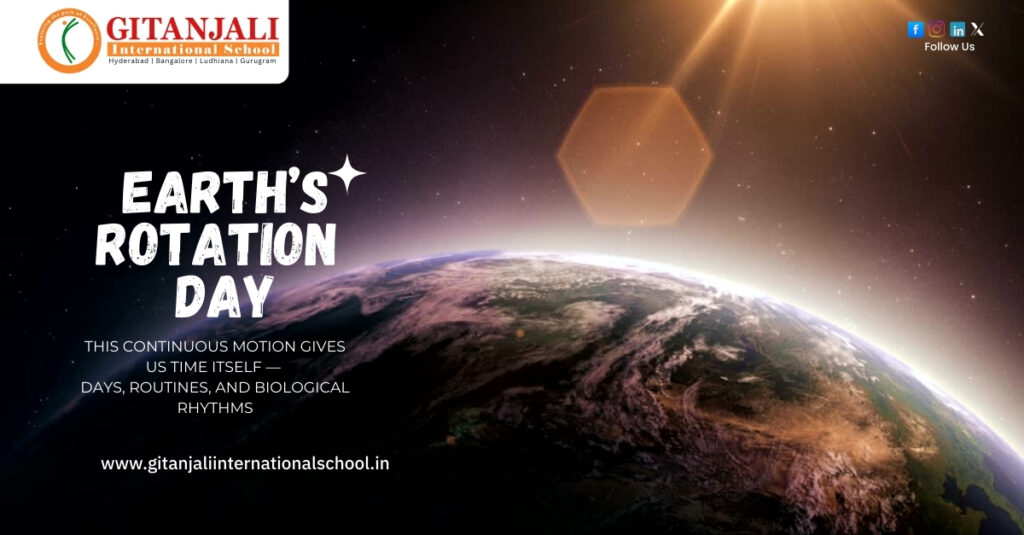
In recent years, scientists have observed subtle yet measurable variations in the Earth’s rotational speed. Though the difference is counted in milliseconds, its implications are profound. The Earth’s rotation governs day and night, stabilizes climate systems, and supports ecosystems that sustain life. When discussions around melting glaciers, shifting ocean currents, and atmospheric changes dominate global conversations, they connect back to one fundamental truth — our planet is in constant motion, and human activity influences its balance.
Earth Rotation Day invites deeper reflection on this dynamic system. It is not merely about astronomy; it is about understanding the interconnectedness of geography, physics, environmental science, and sustainability. What happens when mass distribution shifts? How do climate patterns indirectly influence planetary mechanics? These are the questions shaping scientific inquiry in the modern world.
Why Earth’s Rotation Matters Today
The acceleration or deceleration of Earth’s rotation may seem like a distant scientific detail, but it reveals the delicate equilibrium of natural systems. Changes in glacial mass, seismic activity, and atmospheric circulation can subtly affect the planet’s spin.
Understanding these shifts cultivates awareness. It demonstrates that environmental changes are not isolated events; they ripple across global systems. For students growing up in a rapidly evolving world, such knowledge fosters responsibility and perspective.
Recent scientific observations suggest that Earth has been rotating slightly faster in recent years. While the change is measured in milliseconds, it has attracted global attention.
Human-induced climate change plays a role indirectly. Rising global temperatures are causing glaciers to melt and sea levels to rise. When mass shifts toward the equator, it can influence rotational speed.
This highlights an important lesson for students — environmental responsibility is not optional. Our actions affect the planet in ways we are still discovering
Connecting Global Science with Classroom Learning
At Gitanjali International School, Kompally, Hyderabad, Earth Rotation Day becomes more than a commemorative event. It serves as an academic bridge between scientific theory and real-world relevance.
The Cambridge curriculum’s inquiry-driven framework encourages students to investigate planetary motion, analyze climate data, and explore interdisciplinary connections. Lessons begin with foundational concepts like axial tilt and rotational cycles before expanding into contemporary research on polar ice melt and ocean redistribution.
By encouraging analytical questioning and evidence-based reasoning, the learning process moves beyond memorization toward deeper understanding.
Experiential Learning That Deepens Awareness
Scientific awareness strengthens when theory meets experience. Through model demonstrations explaining angular momentum, collaborative climate research projects, and structured discussions on sustainability, students gain practical insight into complex concepts.
This experiential approach nurtures critical thinking and teamwork. It enables learners to articulate scientific ideas confidently while recognizing their role in environmental stewardship.
Recognized as one of the best residential Cambridge curriculum schools in Kompally, Gitanjali International School integrates academic rigor with immersive learning experiences that cultivate curiosity and responsibility.
Leadership, Responsibility, and Future Readiness
Education today must prepare students not only to excel academically but to interpret global challenges thoughtfully. Understanding Earth’s rotation becomes a metaphor for balanced decision-making. Stability — whether planetary or personal — depends on equilibrium.
Through guided discussions, research presentations, and sustainability-focused initiatives, students gradually evolve into informed leaders. They learn to analyze complex systems, communicate ideas effectively, and approach challenges with resilience.
Such development extends far beyond a single observance day. It shapes character, sharpens intellect, and instills lifelong responsibility.
Key Activities Conducted:
- Science Demonstrations explaining Earth’s rotation and the day-night cycle
- Model-Making Activities showcasing planetary motion
- Poster-Making Competitions on climate change and environmental responsibility
- Group Discussions & Debates on how human activities influence Earth’s balance
- Interactive Presentations by students on recent scientific findings about Earth’s faster rotation
These activities encourage curiosity, teamwork, and scientific thinking among students.
A Commitment to Thoughtful Education
The educational system at Gitanjali International School bridges three domains which include current global conditions and scientific progress and ethical understanding. Earth Rotation Day serves as a reminder that knowledge reaches its maximum effectiveness when people take action based on what they have learned. Students who grasp bodily movement and its consequences together with system interconnections will develop skills to handle the growing complexities of modern society in a responsible and self-assured manner.
- Why is Earth Rotation Day important for students?
It helps students understand planetary science, climate systems, and the interconnected impact of environmental change. - Can climate change affect Earth’s rotation?
Indirectly, yes. Melting glaciers and mass redistribution may cause slight variations in rotational speed.
3. How does the Cambridge curriculum enhance scientific learning?
It promotes inquiry-based education, research skills, and interdisciplinary understanding.